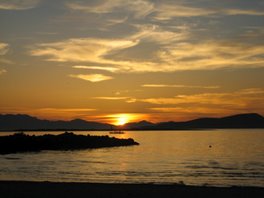
After a wonderful stay in Vava'u we are preparing to set sail for New Caledonia. Steve and Stephanie left for New Zealand on the 7th of May and recent weather has not been so good for heading West. We saw some spectacular coral here in Vava'u and overall Tonga is the best that we have seen. Neiafu is the small capital city that is young and vibrant.
Stephanie and I waxed the hull before she left so that was quite an undertaking; we needed a flat anchorage, but with enough wind to keep us slightly under boiling temperature. The other work that has to be done will happen in New Caledonia before she goes on the market. We have not yet done a passage with only three people so this next sail will be a new experience. It should take about a week to nine days, depending. I had my birthday here in Vava'u and I simply could not believe that a whole year has gone by. But we ate a lot of good food and did some wonderful snorkeling. After being in the marine environment for so long it is amazing how much I am craving to swim in fresh water (i.e. Lake Tahoe). We'll see how quickly my wishes come true.
We are leaving here right at the beginning of both whale and cruising seasons. Apparently the best time for whale watching is also the busiest for boats. It has been nice coming West early, albeit weather risk. There are fewer boats and it is hard to imagine how busy this harbor gets by August and September. Now our trip is coming to a real close. All we have left to do is work on the boat, which can be fairly hard in this heat. There is always water that's awaiting you though. I really can't wait to see the Golden Gate again.
Giovanni
Monday, May 12, 2008

Thursday, May 8, 2008
Tonga -- April 23, 2008
Tonga is a beautiful country, it was never colonized so it retains a culturally independent spirit. We entered into the less visited Ha'apai group, geographically central to the country. The capital, Nukualofa is to the South and the popular Vava'u is farther North. The islands of the Ha'apai are mostly coral atolls, but some have been raised or sunk depending on the whims of the fault line at the Tonga trench. The people and the villages we saw are still part of the old Tongan way of life, mostly all subsistence living. Aid money has brought in solar electricity to some of the villages and gives them a taste of some comveniences. The snorkelling that we did was probably the best we have seen on our trip so far. Some of the uninhabited atolls have spectacular reefs in the vicinity. I bolstered up my cowrie collection; the shelling was fantastic. We got some rainy and overcast weather so we were stuck in our anchorage for a few days. Moving the boat with so much coral and no sunlight to see could turn out to be disastrous. We left the Ha'apai on the 15 of April and set sail for Vava'u. We had weather reports predicting bad weather so we wanted to get into Neiafu harbor. The winds were not so strong so we needed to run the engine to make it in by sunset. The Vava'u group are raised atolls with deep channels between them. The harbor at Neiafu, the capital, has been used as a hurricane shelter. It is quite a lively town, a lot of foreigners have sailed here and simply stayed because it is so beautiful. The provisioning in Ha'apai lacked fresh vegetables and cheese, but we found big yams which were delicious. The markets in Vava'u carry a lot more produce and with the onset of the cruising season the selection is bound to increase.
We have been doing some work to make the boat more presentable on the market in New Caledonia, cleaning and fixing. Our plan is to sail direct from Vava'u sometime at the beginning of May, providing there is a good weather window. We are at the tail end of the cyclone season and it remains to be seen if another could be generated or not, but the chances are now only diminishing. Once in Noumea, New Caledonia, we will have some work to do before we can board a plane bound for San Francisco. The bottom has to be painted while hauled out, there's a lot of cleaning, and we should move most of our stuff off of the boat into storage.
Steve is arriving here in Vava'u today and he will be staying with us for a little while, enjoying the island experience that he and Nico missed out on after the crossing from San Francisco. After the time on the boat, Stephanie and Steve will spend some time travelling in New Zealand. Everything we have heard is that it is a beautiful country. A French family that we met in the marina in Tahiti just went there and thoroughly enjoyed it. Right now our trip is really coming to a close. A year has almost passed, it went quickly but it has been so filled with memories and experiences. Sailing has transformed from something that we did occasionally on the bay as a family to an enjoyment that will stay with me for the rest of my life. For my parents, the trip has given them a clear idea of what are necessary design elements when purchasing a boat for them. This is a lesson that only experience can teach, so the purchase and outfit of a next boat, once our Haapsalu sells will be clarified by first-hand knowledge. I am trying to add some more pictures to our blog so you can take an updated look.
Tuesday, April 1, 2008
Niue and ENGLISH!!!
Our arrival to Niue was unique, we were utterly amazed at how flat the island appeared. Niue was formerly an atoll, but volcanic activity raised the whole lagoon area a few hundred feet. So the island is a big plateau. It is quite large but many people have taken advantage of the free association with New Zealand to go and live there, thus population is actually declining. It definitely retains the feel of an old South Pacific Island. It is not a huge tourist destination and many of the natural features are protected. Overall it was a beautiful island to visit and hearing English after so many months of French was quite an experience. Niue was devastated by a cyclone in 2004 but the landscape has recovered, the coral is still in the process however. The waters are very clear because rain simply percolates through the limestone of the island without taking runoff sediment. There are tons of sea snakes in the water but they pose no threat really and we saw a number of turtles there. The limestone also has created beautiful caves all around the island. The problem with Niue is protection at harbor. Only Alofi Bay has any moorings for yachts and most other places are too deep to anchor. The whole east side of the island is shear cliff and the west side drops off quickly as well. Our visit was cut short because of weather, westerly winds were predicted. With the swell increasing as well as the wind at our mooring we decided to head out to sea, start sailing for Tonga. Our other option was to head to the east side of the island, hove to, and wait out the weather, but we decided to set sail in the evening. We went right into rain squalls and bad weather. The wind was a steady 40 knots, rain, and confused seas for all of the next day. We hove to twice but then decided to see if we could sail out of the weather, finally by this morning the weather cleared. Everything on the boat is salty and sour so we will have some cleaning when we get to Tonga. The weather was particularly hard to handle on our first 24 hours out to sea, we had no time to get out sea legs back on. Even with our second reef in the main and our jib reefed way down we were still overpowered, burying our rail. With the rail underwater we had some intake problems, our sink overflowed as well as a head. The boat handled well so that was comforting but a third reef point on the main would be useful. Overall it was a good experience to have because it brought to reality our sail home if we are going to undertake it. On a well equipped boat, set up for wet seas possibly with inside steering, the trip would be a fun sail. Either way it could also be cold and miserable. We definitely got a feel for how the boat handles and what sailing becomes in that kind of weather.
Giovanni
Giovanni
Niue Here We Come
We said goodbye to French Polynesia and sailed out from Bora Bora on March 11, bound for Niue. Niue is a small island nation in association with New Zealand. It is supposed to have spectacular diving and snorkeling because all of the groundwater filters through the limestone rock on the island. It is situated west of the Cook Islands, mostly South of Samoa and east of Tonga. Our crossing so far has gone well. We have done consistent 150-mile days. Winds have not been too light or strong, but occasional rainsqualls have stirred things us a bit in the last few days. It is a 1065-mile trip. The sailing has been mostly down wind, varying between off a stern quarter and dead down. We never hoisted our main, but instead put up a second jib. My dad brought back the old jib that came with the boat when he went back to the States in December. Somehow we had forgotten it when we originally left. With two headsails up on spinnaker poles, there's no flapping and banging by the main and sailing during the night is comfortable. In a rainsquall yesterday while I was on the helm we heard a bang and then I see the spinnaker pole flying forward. “All hands on deck!” The sheet to the second jib had snapped, we hadn't attached two sheets because it was our second sail up, so the sail was out of control with wind and rain incoming. We managed to bring her down and put her away as well as securing the pole, which broke free from the mast for an unknown reason. Maybe it just wasn't quite secure to begin with. Now the sail's back up. Two sheets this time. We also got a big hit on our fishing rod but the line snapped, very disappointing. We are still about two days out and we'll probably have to head to nearby the island and wait out the night. It will be strange hearing English spoken again. Our whole trip has been in French Polynesia up until now, so we have become quite accustomed to hearing French. This will be a change. Right now we are still in our planning stages for the end of our trip but we will get the boat back home instead of leaving it somewhere. We can either sail it or ship it. It depends on crew and what we are up to. It is a long sail, but coming in under the Golden Gate is quite appealing.
Giovanni
Giovanni
Monday, March 10, 2008
FIRE
We have sailed over to Moorea a few times, and when Stephanie and Nancy came we went to Huahine, but we always managed to return to Papeete, for our visa or for the wind generator. Now we are on our way. Spending time on Huahine was beautiful. We toured the island by car which did not take so long, but the views were spectacular. Once we returned for our visa extension we saw some of the movies in the film festival, which were all well made and interesting. They covered a huge range of topics but all centered around the Pacific islands (Australia included). My dad, Dylan and I went surfing a few times over at the beach break at Papageno in Tahiti. I saw some good improvement, and my board sustained some injuries. After all that we left for Moorea where we stayed for only one night because the winds were just too good to pass up, so we set off again heading for Raiatea in the evening. The wind generator, recently installed, had been doing a pretty good job. We have two solar panels on the stern so we ran the wiring for the wind generator together with the solar panels. Both went throught a 25 amp charge controller (regulator), which was a little small but it was only temporary. Anyways, come a middle of the night rain squall and there's an electrical smell down below. My dad and Stephanie are on watch. I sort of wake up and hope that I can continue sleeping but the smell is only getting stronger so I get up. Out of the back lazarette smoke is sort of billowing out, surrounding Stephanie in noxious fumes. We looked in at the stern but saw no flames, so we reconsidered and my mom and I looked down below. The regulator had melted; it was mounted below the starboard aft bunk. I peeked through the cushions and saw a lot of smoke. I started taking off the cushions and then made way for my dad with the fire extinguisher. He lifted up the board and the fire flamed with new fury from the intake of oxygen. The board was put back after my dad attempted swatting the fire. It took two brains to overcome the complexity of a fire extinguisher, which is locked with a pin. The lever is on top of the handle, not a very ergonomic design so I pushed the lever while my dad aimed the thing. The fire was out, and the whole cabin was covered in white ash that smelled horrible and probably did a number on all of our lungs. The night proceeded as normal.
It took quite a bit of cleaning to spruce up the cabin, but we managed after quite a bit of sleep. This of course is only a side-remark on our ongoing war with ants. We have the worlds smartest on board. They are incredibly quick and they hide. They run into the cracks or crevices that are too small for our fingers. Furthermore, they love damp plywood, so they have hatched some baby ants on board near the condensation from the fridge and other choice places. We have been inhaling more noxious fumes from the penetrating epoxy sealer that makes the wood less inhabitable. So far the war rages on.
We had a great time in Raiatea. I got to paddle an outrigger, which after flipping in the first ten seconds turned out to be really enjoyable. We also ate the best pig of the trip so far.
Right now we are on Tahaa and Benoit, from Makemo, is visiting us. We are on the closing end of our stay in French Polynesia and we will depart soon for the Cook Islands. English comes.
Giovanni
Notes on a Tahitian Dance experience
Today my heart is soaring, yet it is only out of a sadness that I am aware of this "incredible lightness of being". We will soon leave Papeete and I attended my final Tahitian dance class today. I will make an attempt at describing my experience at this unique school. The "Heiragi Ecole de Danse" is this amazing (and I am sorry to say rare and unusual) space where women of many ages and backgrounds gather to study Tahitian Dance. The owner whom I fondly refer to as "Il Generale" is of Tuomotan heritage and infuses the school with a cultural force that proudly displays the beauty and strength of the Polynesian people. She brings a deep sense of her culture and for her it is dance that is a woman's expression of Polynesia. She expects us, the learners of this kind of dance, to come each day ready to work and to keep on working (she often reminds us, " boku travail"), both to learn the dance forms in an exacting yet artistic way, and to know the Tahitian words for the individual moves. When she attends the classes everyone becomes just a bit more serious in their studies, yet she also brings along her big belly laugh that reminds us of our shared womanhood. I call her assistant "La Professora", and she very sweetly gets each dance class started, and the very difficult labor of learning this dance begins almost effortlessly under her guidance. She too brings along a good humor and suddenly we are all laughing because she has imitated our awkward attempts at a particular form, then the laugh is over, now she warmly gives us the corrected move. Many women look in the mirror as they attempt to imitate her; as for me, I am so far from approximating her form that I simply watch her and imagine that it is my body moving with just the same grace as hers. We " ladies of the dance" come in all shapes, our common thread being women joined together in the learning of this art of Polynesian Dance, and it is interesting how beautiful we are each becoming as the work begins to reshape us just a little and gives us a bit more grace. There are a handful of women that are of Polynesian heritage, the two dozen others are mostly from France with a sprinkling of ladies from Australia or New Zealand, and me, the lone American. Children often attend the classes and become a part of the dance. The baby in the stroller who begins to fuss is cooed at by anyone near, the dropped toy retrieved as one of us dances by, and when the fuss becomes a near scream, the baby is suddenly in a mother's arms, the arms usually belonging to "Il Generale or La Professora", the baby now happy to watch our mostly clumsy display from a new vantage point. Newcomers are always welcome in this school, even now as the dance school begins the more serious preparation of their performance for "Heiva", a huge cultural "fete" held in July. "Il Generale", actually Veronique Clement, has chosen the songs and created a choreography that she and Selena, "La Professora", are teaching us. As we learn the individual moves and begin to put them together, she also writes out the Tahitian words to the songs and explains just what our gestures are meant to convey. The dance forms that are often described in the French language are now frequently referred to by their Tahitian names and we students must know the meaning. Since my days at this special dance school have come to an end, Jeff joined me at the class today to take photographs of all of us hard at work. I introduced him to a woman in the class I call "my Tahitian Idol" and asked him to watch her move and attempt to capture that on film ! This woman is much shorter than I and quite a bit more broad, her movements are completely fluid and graceful and she never seems to tire, her hips just keep on circling round and round as if this is the way a woman's body is made to move. The only way to perceive just how hard she is working is to be close enough to see the wet glow of her skin, or when her butt length hair falls out of its clasp as she dances. For me, she absolutely shines with a true womanhood, the kind that many of us belonging to the world of the dominating cultures are attempting to obliterate with our excessive thinness and surgical sameness. If you were to attend this class I think you would agree that the fashion photographers of the modern day are really taking photos of nothing, the emaciated, hollow-eyed, soulless shapes being nothing when compared to these dark- haired, full- figured beauties. My heart soars at this very lovely and surprising experience here in Tahiti, and I know that although I can grow my hair long, clasp it up, wear a pareo as my dancing skirt, it will not be so easy to build a space that carries an equal amount of feminine strength in its architecture as the simple "Heiragi Ecole de Danse". Maururu Roa to Veronique and Selena and all the "dames de danse" of Tahiti.
Ia Orana, Teresa
Ia Orana, Teresa
Friday, January 4, 2008
Holiday Festivities
Holiday festivities started right on time here, which is of course way too early. People began setting off fire works in early December already shouting Merry Christmas and Happy New Year. The weather was entirely too hot for us to even imagine that it was Christmas time, much less have our normal holiday cheer. Nevertheless things quieted down around the marina. David and Stephanie left for San Francisco on December 22, so Christmas was just my mom and I but we also celebrated with Dylan, from Australia, who we had met in the Marquesas, and just to make sure everything was unusual, we made fondue.
This is the summer season and December is said to be the wettest month and the weather has definitely lived up to its reputation. It rained almost every day in December, sometimes for hours nonstop, but at times other it was clear and beautiful. I have been taking surf lessons and the learning curve is slower than I expected; it's still a lot of fun.
We ended up buying a new dinghy and engine here because our old one is quite big and it is fully inflatable so getting it up on a plane was rather challenging and our 15 hp engine weighs a bit too much for comfort. We bought a smaller rigid bottom inflatable with a 9.9 hp engine and so far it has worked fabulously. Yesterday we tied a rope on to the stern and went scurfing (getting towed behind the boat on a surf board). We had heaps of fun and lots of laughs and certainly is an activity worth repeating many times over, especially in this heat.
It is truly amazing how much heat effects my motivation to get up and do things. When I am just sitting on the boat dripping sweat from doing absolutely nothing it is kind of hard to just get up and start moving. Grocery shopping and the general errands for living always leave us completely drenched. Swimming is always the easiest activity for obvious reasons.
We left home on this trip with nothing in the world of tv entertainment besides some PBS dvds. Here we discovered the wonderful world of watching other people's dvd collections. I even found a few in German so that has been fun attempting to brush up. Nevertheless staying in this marina for so long has been challenging, both my mom and I are ready to start moving again. Just bearing witness to just how much materialism has permeated the far reaches of our planet has been slightly depressing. Furthermore the city of Papeete gives the atmosphere a completely different feel from community centered outer islands, which are our personal preference; you are able to connect with the people in a much more human way. My dad missed his flight from LA so he is flying in early tomorrow morning but we will remain here to finish up some work on the boat before we set sail again. The departure date is however inching reassuringly closer.
Thursday, December 20, 2007
Pictures From The Voyage...
Below, lies a link which is the gateway to pictures from the begging of our voyage in July until Easter Island on November 15th. Just click on the link below and it will connect you to a picturesque recap of our journey.
http://picasaweb.google.com/giovannisaarman/
http://picasaweb.google.com/giovannisaarman/
Rapa Nui, Easter Island -- December 3, 2007
So we ended up buying tickets to visit Rapanui (Easter Island). We thought that when we re-entered French Polynesia our visas would be renewed but that was old informationg. Never the less it was a wonderful experience. We stayed there for a week and the weather was much colder that what we had experienced in French Polynesia. The biggest relief for us all was that finally we could get by on our mediocre Spanish rather than our non-existent French. For me it just felt so much more like home. It is a spectacular island and learning about the history was also really interesting. My dad went there on his first year-long sailing trip, when they raced in the Trans-Pac to Tahiti, but a lot more archaeological work has been done since then. Looking at an island that was completely deforested on behalf of human interests was enlighting as to how much influence we can have as a people on our environment. When we were there, the Esmeralda, which is a Chilean navy ship came into the harbor so we got to watch the soccer game between the locals and the military. The island is the most isolated in the world. When you are there you can feel this sense that this is the only spit of land for a long way. It is just in the Pacific ocean without anything nearby. We went on tours of the archaeological sites on the island and we spent one day riding horses which was a lot of fun. Perhaps the most amazing aspect of the culture there is that the population was reduced to only 111 people at one point. From those the people have recovered tremendously, and have restored a great deal of their original culture. The population was decimated by disease and slavery. Now with the influence of the modern world, drugs post a horrible threat to the serene island life. Like many of the South Pacific islands, the importation of drugs destroys the culture. Overall the trip was a great experience, and the Chilean government has done a good job of maintaining the island.
Thursday, November 8, 2007
Toau -- November 1, 2007
Halloween sort of passed us by. It's hard to keep track of the date and the day of the week, but we were on an overnight passage on Halloween. We were sailing from Toau to Rangiroa. Toau is one of the smaller atolls that we have visited and very few people live there. Near the pass into the lagoon is a village that has inhabitants only during copra season, which is when the coconuts are harvested and dried so that they can be sent to Papeete to be turned into oil. We did not however enter the inner lagoon because it is uncharted. There is a family that lives on another one of the motus. But they have a small bay with moorings for boats that is directly accessible from the ocean. It is a well protected harbour and could almost be used to wait out a tropical storm. The mooring are better for the coral ecosystem because anchors tend to damage the coral. The two sisters of the family each have their own working life cut out for them with their husbands and children. One sister has a small pearl operation and sends fish to nearby Apataki for export, and the other sends fish to Fakarava, raises pigs and chicken, and has a small pension. For us is was astonishing how many fish they caught each week; we were sceptical about how long they will be able to continue this until they have overfished. They mostly set up fish traps, but in the process of trapping the parrot fish, many of the other fish are killed as well. For them they simply supply the fish to meet the high demand for poisson cru which is a specialty of French Polynesia.
Toau is one of those islands where cruisers tend to loose track of time and a proposed week stay soon turns into a month. This however could not happen to us because my grandparents are leaving soon on a plane from Rangiroa, but we stayed as long as we could. When we first arrived there were nine boats in total, but by the end we were the only ones for the last few days of our stay. They cooked food for us and it was spectacular. The sister who has the pension had three close to us in age so it was nice to meet them. We have had so little contact with people our age because the majority go to the Society islands, especially Tahiti for school. Leaving Toau was quite hard because all of us enjoyed the island.
The sail to Rangiroa was a typical Tuamotu sail for us; we always seem to leave when there is barely any wind. Such is life! Rangiroa is the biggest atoll of the Tuamotus and it has three passes but they are only on one end of the lagoon, which is 45 nautical miles long. When we came in the pass there was some wave action and we were greeted by a pod of bottlenose dolphins who had come to play in tidal swells of the pass. They were overjoyed to ride on our bow wave. There were some small boats from the hotel with passengers who had come to see the dolphins and they got a great show because of our boat. The dolphins were jumping out of the water and then quickly slapping there tails on the surface of the water, something we had never seen before. The highlight was when three or four of them did this simultaneously. Dolphins are always overjoyed to see a boat in the water. They suddenly show up near your bow, give a show, and then leave as quickly as they came. Some pods stay longer than others, often depending on if they have turned out of their way to meet you or not. It's unthinkable how someone could want to hunt them because they are always so happy to come into contact with humans.
Thursday, October 18, 2007
A Fiasco in Papeete - October 16, 2007
So we had along, unplanned stay on the island of Makemo. We met an extremely nice family there, and I also had some medical issues, but I'll explain that later. Right now we are in Tahanea, but we have had rainy and stormy weather for a good five days; an occluded front is passing through. My mom's 51st birthday was the on the 13th, my grandmother's 84 was on the 4th, today is my grandparent's 59 anniversary, and tomorrow is by brother's 22nd birthday. October is a full month. Makemo is a beautiful island but we had to keep going.
During our stay my brother and I decided to get SCUBA certified in Makemo. The instructor spoke broken English so most of it was watch and learn experience rather that aural explanations. Anyways, our first day of diving was fine, only in about 15 feet of water. I got a headache underwater and when the class was over and we had surfaced it really began to pound. I usually do not get headaches, but it subsided after about 45 minutes. The next day as soon as I went into the water my head started to pound again. It was started again later on by simply putting my head underwater. Then I went to snorkel and dove down, but when I surfaced I was in so much pain that I wasn't sure if I could swim back to the boat. Nobody was in the cockpit and the engine was on, but I managed to swim to the kayak tied to the stern. That was the worst pain I have ever been in, much more painful that breaking a bone, and I have had plenty of that. That night, I finally slept after 5 melatonin and 10 vikodin in 8 hours. The next day we went into the tiny clinic on the island and later took the flight to Papeete, Tahiti. There I went to the emergency room. After a long wait I was finally seen, but the state of the hospital facility was not encouraging. I had a CT scan, which came back negative. The doctor was not satisfied so she performed a Lumbar puncture; she drew spinal fluid from between two lower back vertebrae. The fluid was clear, no sign of blood which ruled out hemorrhaging or meningitis. After that procedure I had to lie horizontal for twelve hours so I spent the night in the hospital. I had a MRI the next day that was a weird experience. It is this huge machine that basically makes all kinds of loud noises at you. That was also negative, so the neurologists were left with the diagnosis of a migraine. It was the first of my life and hopefully the last. It was reassuring however run down the building was, the hospital in Papeete was first rate care, because it is the only place in the middle of the Pacific for medical emergencies. The strangest part of my migrain was that it would get incredibly intense and then lessen but not go away. Even after leaving the hospital, I got the sharp pain a few more times. I saw a homeopath/acupuncturist in Papeete before we flew back, and he told me that I needed to drink more. At that point I had taken a beta-blocker because my mom wanted to see if my headache had anything to do with the fact that I had recently taken some for my fast heart. Since I didn't need it, my heart rate was down to 38 or 40 so it only made my headache worse, but the beta-blockers wore off.
When we got back to Makemo we found out that Lee Wood, my mom's friend and my former pre-school teacher had decided that life on a boat was not suited for her. Titou also went home so no it is only seven of us and my grandparents leave in early November.
We moved anchorage to the old village on the other end of the island and spent a few days there. We decided to do a drift dive in the pass one day because we had been told that it was spectacular. My parents, my grandfather and I went to go snorkel and we completed two drifts. Then my dad wanted to go check out the other side of the pass in the dinghy, so my grandfather went with him and my mom and I stayed to snorkel. We had seen some sharks in the pass but they were all they way on the bottom in forty-feet of water. We swam into the shallower areas into less that ten feet. We saw some black tip reef sharks, but we have become used to those. Then something caught my eye, I called to my mom to alert her; there was a 12 foot lemon shark swimming in about 4 feet of water. Lemons are known to be aggressive and our whole philosophy had been that we would be safe in shallow water. That shark turned over everything. There we were stuck without a dinghy, but the shark moved on and my dad ended up coming back soon thereafter.
After the storm set in, we decided to leave our relatively unprotected anchorage for Tahanea. It was a short six-hour sail because we were doing a consistent eight or nine knots. Now we have been stuck with rain for a while but we plan on continuing to Fakarava shortly.
Now we have a new way of updating the blog so I should be more reliable and consistent.
Best wishes,
Giovanni
Wednesday, October 17, 2007
A Long-Awaited Update - September 24, 2007
We spent a little more than a month in the Marquesas Islands. On the North side of Nuku Hiva we stayed in the spectacular place called Anaho Bay. In the next bay over, Hatiheu, we met really warm people and we got to visit some of the old archaeological sites of the island. We returned to Taiohae after Nico and Steve left from Hatiheu and re-provisioned. After a few days there, we left for the island of Ua Pou. It was only a day sail to the South with beautiful weather.
On Ua Pou we anchored in two different bays, Hakahetau and Hakamaii. The people in the second town were very nice. We were pressed for time because we have to be in Tahiti before hurricane season comes in mid-November, so we left for Tahuata, again heading farther South. On account of winds, we continued beating to the most Southern Marquesas Island, Fatu Hiva. There we stayed in the beautiful Hanavave Bay. It was originally called the Bay of Penises because of phallic rock spires that adorn the hillsides but the name was changed to bay of virgins by adding an e to the French name. We hiked to a waterfall there, which was about 120 feet tall and swam in its deep pool. We saw a whole bunch of waterfalls on Nuku Hiva but we didn't hike to any; this was our first. We then sailed over to the town of Omoa where we were able to buy some tapas, which are pounded tree bark that has been painted with traditional designs using natural ink. There we met a woman who my dad had taken a picture of on his last trip. He and his brother had been hiking over the hill from Hanavave to Omoa and crossed paths with a group of four women about their own age. The woman we met was the only one of the four still living on the island and she could hardly believe it. In Omoa we also met a dentist who lives on Hiva Oa and a schoolteacher from Papeete.
We left for Hiva Oa after a few days. We visited the main town of Atuona mainly for supplies. The dentist we had met, Alex, and his wife Linnea were welcoming and took us around the island. Linnea is part Finnish so it was great for her to meet my grandfather who is Estonian.
Our next stop was in Tahuata, which is a small island only about five miles from Hiva Oa. We had heard that it is exceptionally beautiful and furthermore we had the names of two bone carvers who live there. We anchored in three different bays and restocked on fruit before we set sail again. The last of the three bays was Hapatoni where we met the bone carver Cyril. He had stunning pieces, the best we had seen, and the neighboring bay was home to dolphins so we stayed for a few days. We saw the dolphins but never got a chance to swim with them. The one time we went over the water was filled with jellyfish so we got in and right back out quickly. We then left for the Tuamotu Archipelago.
The Tuamotu islands are South of the Marquesas and East of Tahiti. French Polynesia is essentially split up into five groups of islands: the Marquesas, the Tuamotus, the Society Islands, Gambier, and the Australs. We only plan on visiting the first three groups however. The Marquesas are steep and volcanic, much like Hawaii, while the Tuamotus are low atolls, only small, palm covered, sandy islands. Each atoll consists of many motus, or small islands, surrounding an inner lagoon, protected from the ocean by a reef. The Society Islands, which include Tahiti, are a mixture of the two, they are tall and mountainous, but have an inner lagoon that is protected by a large reef.
Our first stop was the island of Raroia. We arrived on September 17th and stayed for a few days. The snorkeling was beautiful but the multitude of sharks was a little off putting. The town there was small but we did get ice cream one day at the little store, but when we went back it was all gone, along with the wine on the shelf that we were going to buy. We left on the 21st for Makemo. It was an overnight sail, but the wind was completely dead so we motored the whole way; we had to be in Makemo by the 23rd because my grandmother was arriving. Coming in was the first time I was on the helm for a pass and it was not so easy. We always have someone stationed up at the first set of spreaders for a better vantage point. The town here is a bit bigger than Raroia and there is a dive shop so hopefully I can get scuba certified. My grandmother arrived along with Titou, a family friend who was on Rapture for part of the trip 30 years ago. My grandmother brought a lot of stuff from home, books, sheets, rope, a ham radio, just to name a few.
We have all read a ton of books, so if you're looking for a good book just ask. It is truly amazing how time gets eaten away on a boat, especially when you are cooking, cleaning, reading, going to buy groceries, and constantly fixing things on the boat. Small tasks become much larger ones. It's surprising that you never really get bored. I hope everyone back home is doing well, to those who have already started school, I wish you the best.
Giovanni
Friday, August 10, 2007
We made it!
Our voyage began on July 16th. We hesitated to depart because we could not find our great circle chart of our trip from San Francisco to the Marquesas, but we ended up making do without it. We took off at around 5:30 am and caught the ebb tide. By the time I was fully awake we were already out the gate; it was a quick farewell. We had a beautiful first day at sea, marked by many encounters with sea life. We saw humpback whales breaching and slapping their pectoral fins on the surface of the water and a pod of dolphins came to play in our bow wave.
We headed off the coast of California, but pretty quickly started South. The winds were light as soon as we left the San Francisco Bay and remained so until just above the equator. This made for a much longer trip than we had intended. We arrived in the Marquesas early on August 8th after 24 days at Sea.
The experience of being on a boat with no land, only water in sight is quite revealing. I got used to it, but when we decided to swim for the first time, even though the winds were almost dead and the boat was going around 1 to 3 knots as soon as I jumped in the water from midship, my only focus was on the rope dragging behind the boat. The speed of the boat is deceiving. The water is so crystalline blue it is absolutely beautiful. Nevertheless it is scary. With our nighttime watches your sleep schedules were not so regular but we got used to it after a while. Nine people, trapped on a boat for three weeks breeds tension. The last few days were far from archetypal examples of cultured compromise. It was palpable that for everyone's well being, we needed land. It came.
It was truly amazing how much life is visible in the middle of the ocean. We were visited by dolphins numerous times, many of which occurred during my nighttime watches. We almost always saw bird life, and flying fish never ceased coming out of the water, frightened by the vibrations of our boat. We caught about six or seven fish on the trip. The ocean is certainly not dead, no matter how far from land you are.
We experienced some difficulties aboard. The inverter for the refrigerator draws so much power that we finally figured out that we would have to periodically turn it on throughout the course of the day because otherwise it drained our batteries. Our electronic charts on the computer took time for us to get them working, but we succeeded. We tore the head of our jib because we had a lightweight drifter up in the main track and we wanted to put up a double head rig, so we hoisted our main jib. However, the luff on the drifter was much shorter than the other jib, but we weren't aware of that, so we kept raising the sail and tore off the track tape as we pulled it past the head of the other sail. We could only blame ourselves. After a night of restitching the sail is was back in commission. Throughout the trip we ate extremely well, so that was a big plus. We anticipated a 15 day trip, but despite the extension due to light winds we had plenty of food. When we finally spotted land it was early in the morning and the islands were so picturesque. The Marquesas are volcanic islands with dramatic rocky cliffs and mountains contrasted by lush green foliage. We came into Taiohae Bay on the island of Nuku Hiva. We were so excited to see land. As soon as we went ashore, we pigged out on fresh fruit. We now have internet access so now I am updating the blog.
Giovanni
Saturday, July 14, 2007
Preparing for a Journey

My family purchased our boat Haapsalu last October and ever since then we have been retrofitting her for an ocean crossing and a year of cruising. We have reconfigured some of the interior, installed electronics for navigation, taken the mast off and put it back on for rigging, and redesigned the dogger and bimini, among many other things. Finally, after posponig our departure date a few times, we are running headlong for the end of our preparations. It has been intense. Right now most of our personal belongings are on the boat stowed away, but the fresh food and well as some other things remain to be packed in.
Just yesterday the whole crew was interviewed by the Maring Independent Journal and our story appeared on the front page today http://www.marinij.com/marin/ci_6363931. It was reported that we are leaving this weekend so we better make the deadline; we plan to leave Sunday morning.
We will cross from San Fancisco to the Marquesas. (photo is courtesy of the Marin Independent Journal)
Giovanni
Midlife Musings
I am fifty years old and about to embark on the first real adventure of my life. This voyage by sailboat across the Pacific Ocean truly brings me face to face with the unknown, also with my truest self. My husband gifted me with a massage yesterday and when Brian (he with the gift of healing in his hands) asked me what I hoped to gain on this journey, I sighed heavily, remembering the cross words that had just passed from me to my sons. The ache of the memory cleared my vision, and I answered, "When you are sailing, the superficial details of life are left in your wake, the sun sets on the horizon and you come face to face with yourself. When that mirror is held before my gaze, I want to improve the view, get a reflection I can live with."
This sailing adventure began 24 years ago at my friend Catherine's wedding. From my very first gaze, when he was playing with a child on the church steps, until the moment of our introduction, he captivated and intrigued me. When we began the simple conversation born of a desire to know another, I discovered that he either told a totally convincing lie filled with countless exciting details or truly he had circumnavigated the globe by sail boat. As I kept firing definitive piercing questions about his journey he continued to sail beyond me with a truth I could only be in awe of. As we continued our courtship, I knew that this man would both become my husband and one day return to his first love, the sea. When I spoke my wedding vows, hidden between the carefully written lines was my vow to be my captain's first mate. My watch as first mate begins tomorrow, 5:16 am, on a strongly ebbing tide of 5.5 knots.
Our vessel Haapsalu will sail beneath the Golden Gate Bridge on that ebbing tide. She has been ours since October and during these past nine months, we have scoured her from stem to stern and keel bottom to masthead windvane. She has undergone a major transformation, yet we have not sailed her with the kind of frequency we dreamt about. Then again, whenever we do sail, we are so completely steady and safe on whatever tack we find ourselves, we feel good to go. Haapsalu is a fine sailing boat and our shake-down cruise to Drakes Bay informed us that our vessel is fittingly named and deserving of her strong heritage. Haapsalu, Estonia, is the town where my husband's father spent his youthful summers sailing on the Baltic Sea. Eventually my father-in-law utilized his seafaring knowledge to sail his way to freedom from the Communist occupation of the Soviet Union, first to Sweden and then to the USA. His family however was not so blessed, and thus became the concept that sailing is a means to becoming a free human being. Paul Saarman is as free of the human constraints of being born into a physical body as anyone I have ever met. He joins us on this voyage and we dedicate our ability to say "YES!" to such an adventure to him.
Our crew of consists of Paul Saarman, our elder and wiser, my husband Jeff Saarman, the admiral I admire, our two sons, David and Giovanni, Jeff's brother, Steve, together with his two children, Stephanie and Nicolas, as well as our good friend and the pre-school teacher of our two sons, Lee Wood. Each of us has chosen this voyage and we are in the final frantic steps of preparation. The closer we get to embarking the less I am enjoying that "view" of myself, although I had become decently enthralled with the reflection during earlier phases of preparation.
It MUST be time to cast off the lines and set sail. But first I must give a kiss to Chuck who sold us this fine vessel, Ari who makes her buzz with the information a modern sailor is blessed to be able to utilize, and Jason, man of all our dreams, who fine-tuned our rig for the best of all possible sails. We also awknowledge Smitty who made Haapsalu stand out in paint, Richard, our guy Friday, engine Chet, David of the striped awning and ceiling carpet, refrigerator Carl as well as info-tec Karl, electric Ryan, which way is North Hal, wind in your Monitor Tim, Clay of all trades, Metal John, Chris and everyone else at Svendson's, all the folks at McGrath Yachts, and Frank.
Teresa
Subscribe to:
Posts (Atom)